
Die geschlossene Gesellschaft und ihre Freunde
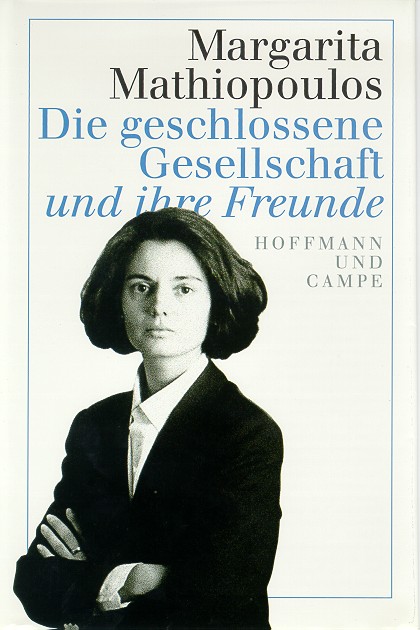
The major opportunity of German unification for deep structural reforms and renewal, and a modernization of the entire German society went unmet. The biggest economic and social crisis of the Federal Republic of Germany with in fact five million jobless is the product of a closed society and its friends. Vis a vis of worldwide competition, the "German model" has proved to be hostile of deregulation, privatization, innovation, and flexibility (the "German Disease"). Adenauer's doctrine of "No Experiments" has apparently survived until today. The "contrat social", signed in the Fifties to guarantee social peace, has turned into a "contrat asocial" in the Nineties.
Margarita Mathiopoulos, an expert on US-politics, analyzes the self-inflicted crisis of a Germany she describes as a degenerated "federal institution under public law" at the end of the 20th century, and argues by tracing back to the roots of German mentality and political and economic culture, that German society has always been security - and tradition oriented - the opposite of the "American model" of trial and error and a risk-taking mentality. "What prevents us tram learning from America, the experiment of progress par excellence?" asks Mathiopoulos and examines the causes of German arrogance and ignorance towards the "American model", from Hegelian theory through Green political ideology today.
The consequences of the German mind-set - a "state socialism" from Bismarck to Kohl – have enduringly shaped the economic and social system of the Federal Republic of Germany. Bismarck's "state socialism", the conservative interventionist state and the concept of "social market economy" lasted in Germany, as Mathiopoulos points out, for decades and were considered to be the ideal synthesis of Manchester capitalism (thesis) versus Marxism (antithesis). Now, however at the end of the 20th century, the model of the "Rhineland capitalism", as foreigners like to name Germany's "social market economy", seems to have outdated itself. At least since we are facing the phenomenon of globalization the German model is confronted with a new "antithesis", writes Mathiopoulos, that calls for a new synthesis.
Modern and innovative economic and social policies in the 21st century will however imply a radical break with any type of conservative state interventionism and reactionary state socialism, if the paralyzation of a closed society and its friends shall be resolved. The greatest danger for our democracy, says the author, lies in a hidden cameralistic consensus between various interest groups - the closed society and its friends - who try to thwart reforms and innovation by hanging on to traditional behavior patterns. Considerable parts of our elite in politics, business, the labour unions and in academia are complacent: sympathizers of a status qua of rigid inflexibility.
The future of Germany as a business site will also be decisive for the future of democracy in Germany. The Bonn Republic has been saved from the rate of the Weimar Republic. The Berlin Republic faces the difficult task ahead to stand the test not in a period of "sunny weather democracy" hut in times of a severe economic crisis. Every free and democratic system must defend itself against its enemies, as Karl Popper demonstrated in his classic, "The Open Society and its Enemies" (1945).
But also formal democratic and free-market societies can mutate to closed systems, so the thesis of Mathiopoulos, when they degenerate to uniform consensus societies that postpone inevitable and essential reforms, sweep conflicts under the rug, and risk "No Experiments".
In her chapter "Modern Times - With or without the Federal Republic" - Mathiopoulos writes about the opportunities of globalization for open societies. The political primacy, the control over the framework of economic competition will be held only by those societies, who can cope with change. Germany, claims Mathiopoulos, needs more liberal democracy, more capitalism, and more political courage. Only in this way can we create more jobs, make economic prosperity endurable, secure social justice, and thus prevent a crisis of democracy. If Germany will be ready to take a chance to move from sunny weather democracy towards competitive democracy, this will not lead to the decline of the West, hut to the end of its closed society. Margarita Mathiopoulos is convinced that Germany has the power to experience a second economic miracle. The question is, whether it has the political vision and will.
Reviews
- American German Business Club e.V. (page 1, page 2)
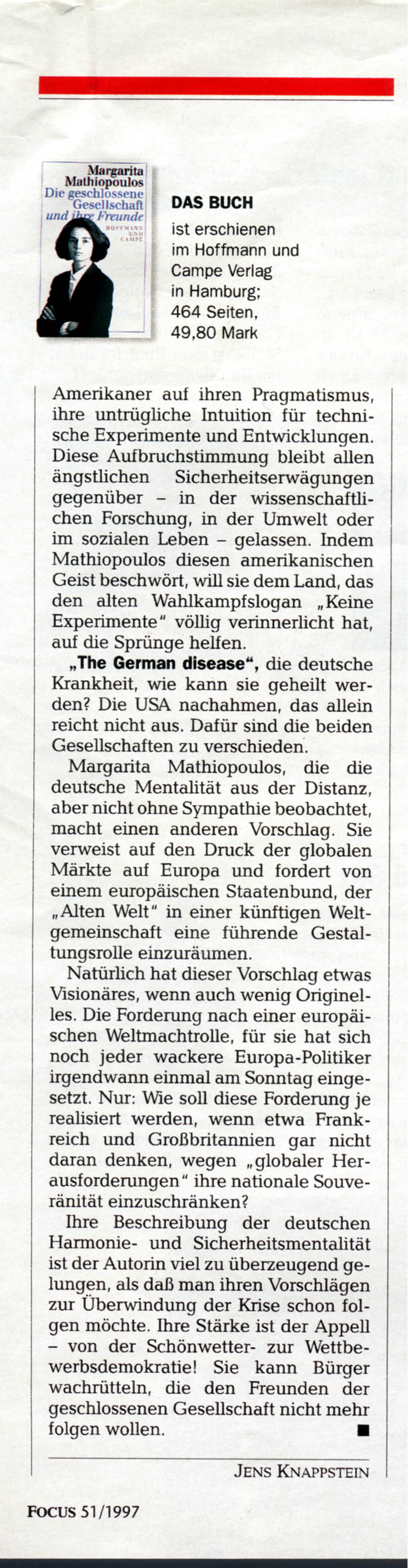
- Focus (page 1, page 2)
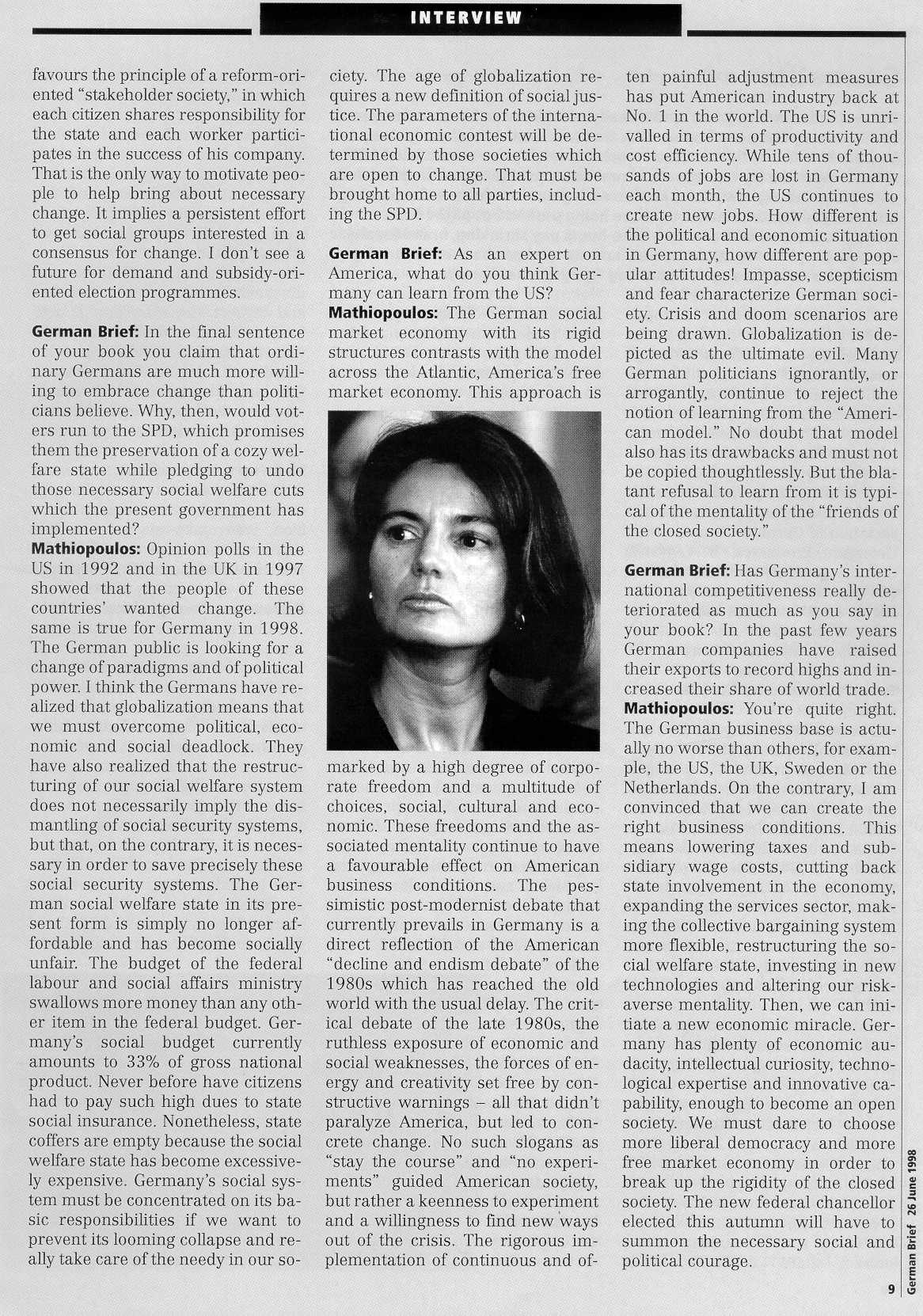
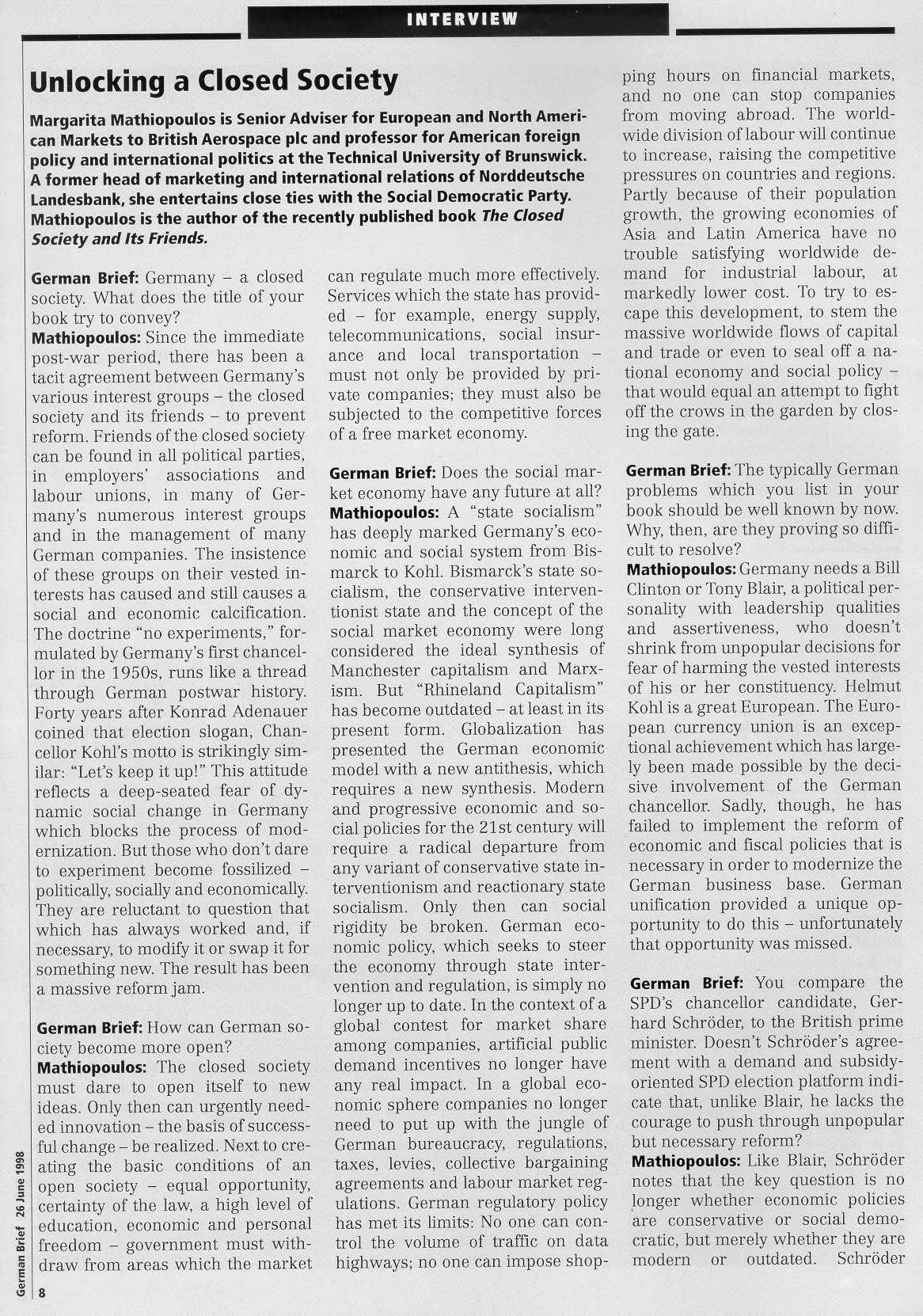
- German Brief (Cover, page 2, page 3)
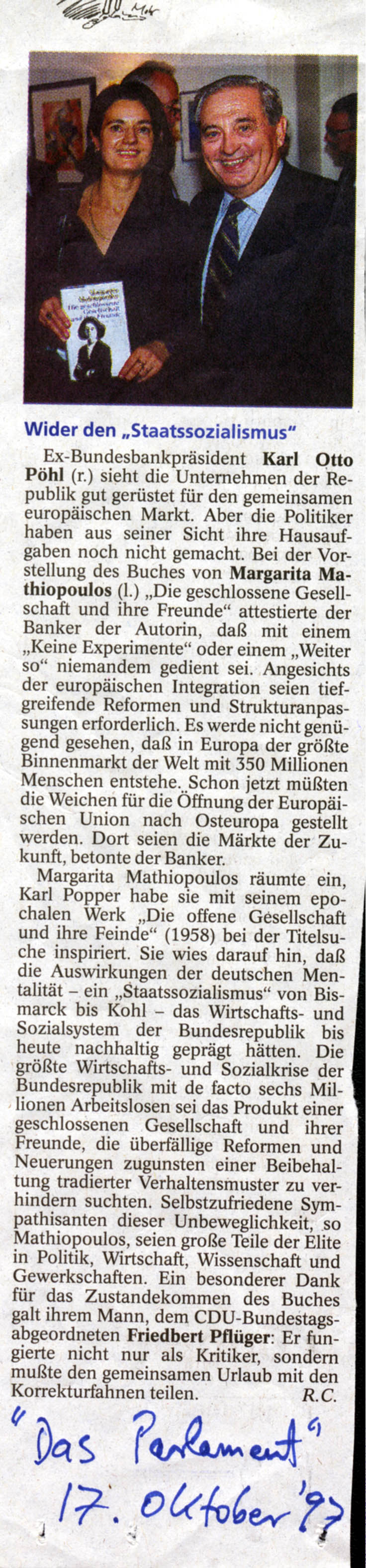
- Das Parlament
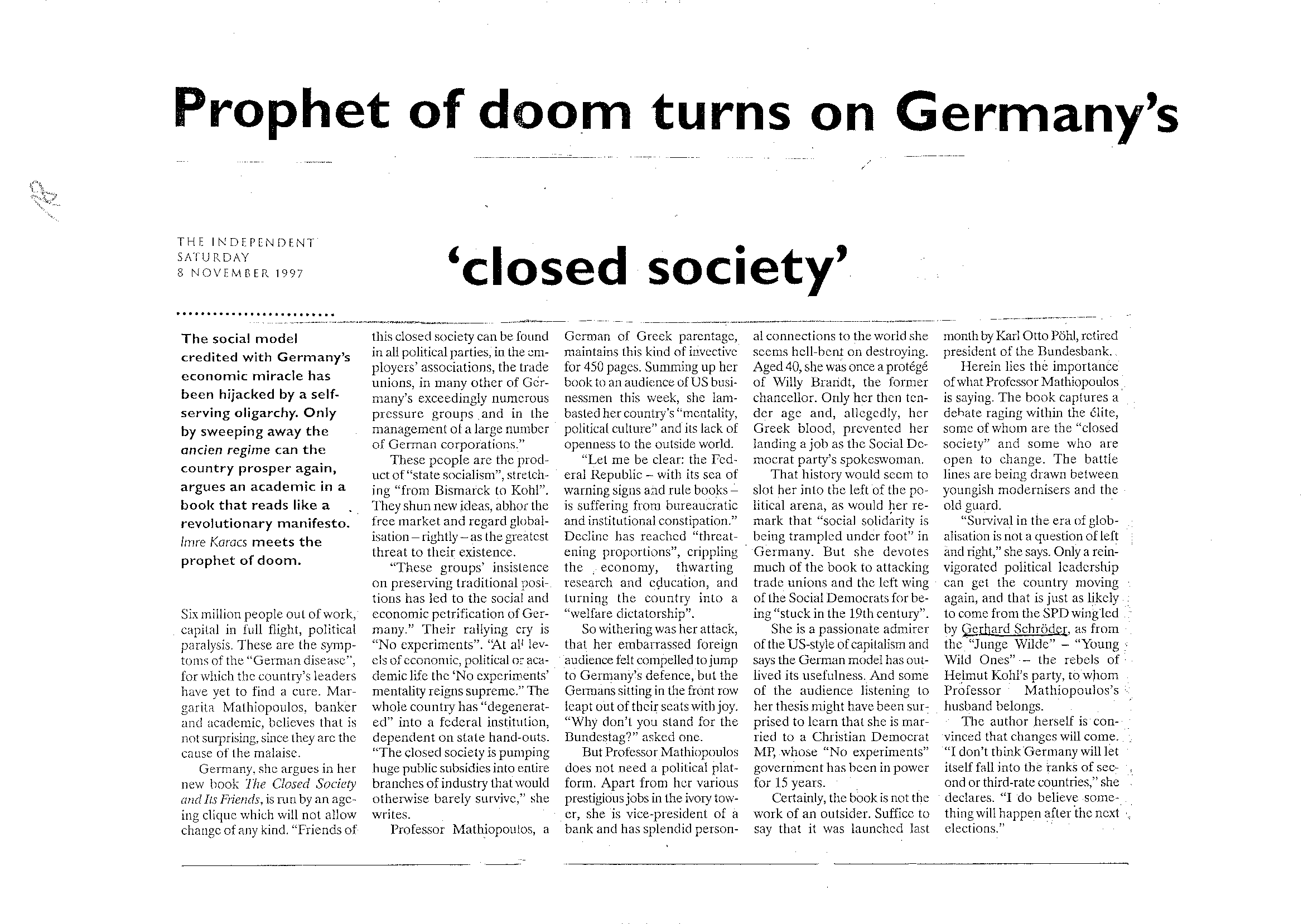
- The Independent
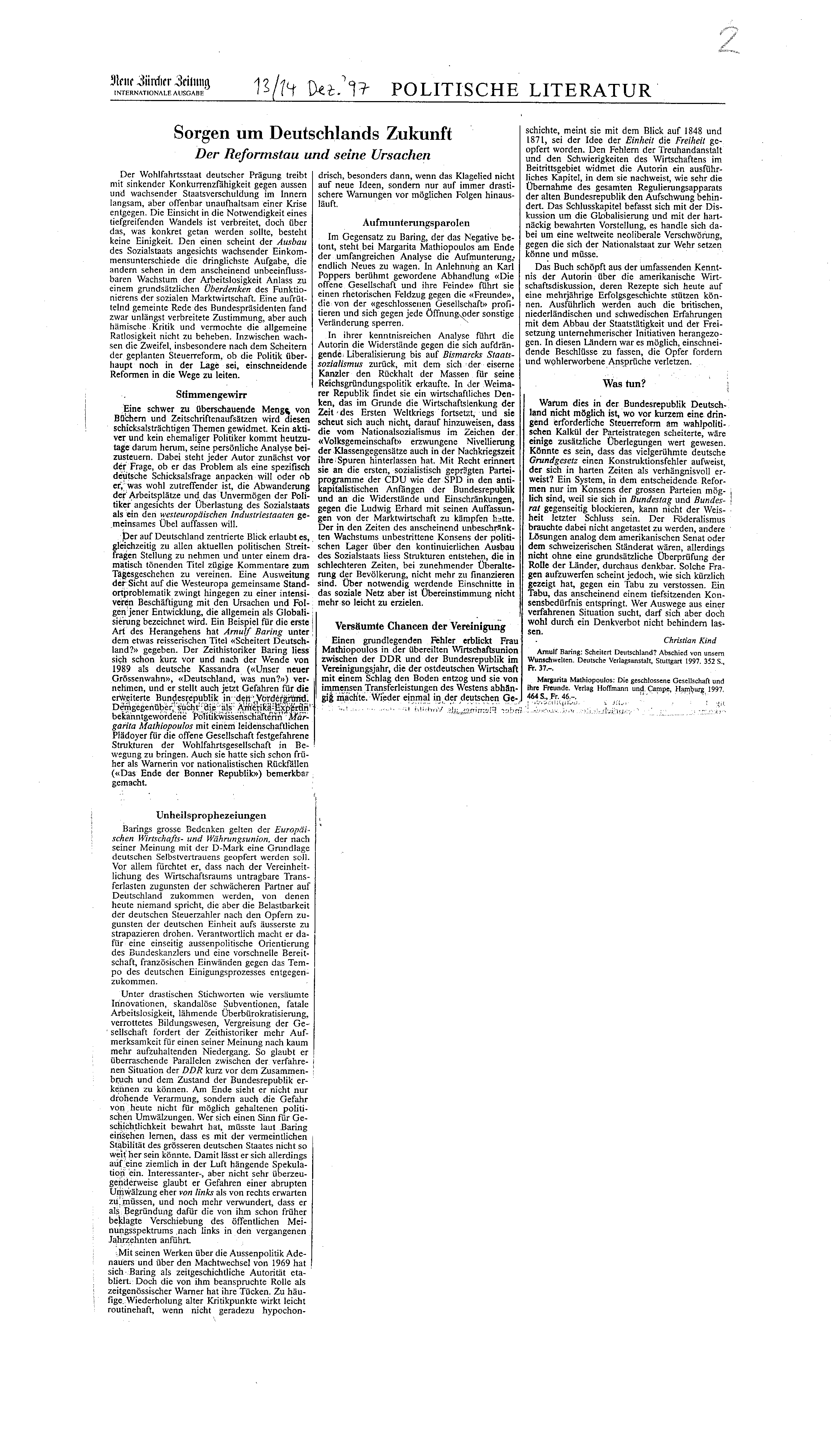
- Neue Zürcher Zeitung
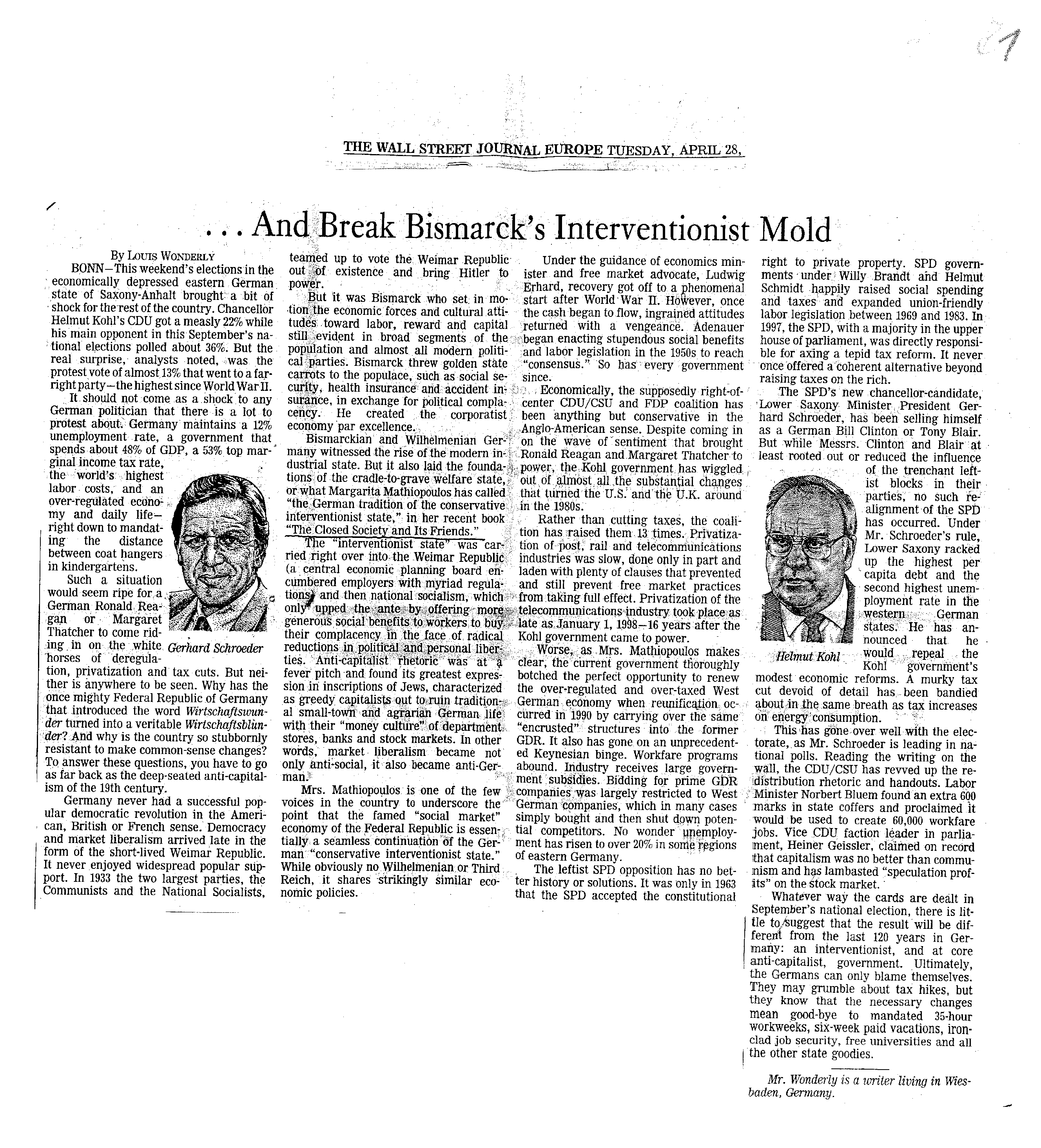
- Wall Street Journal Europe
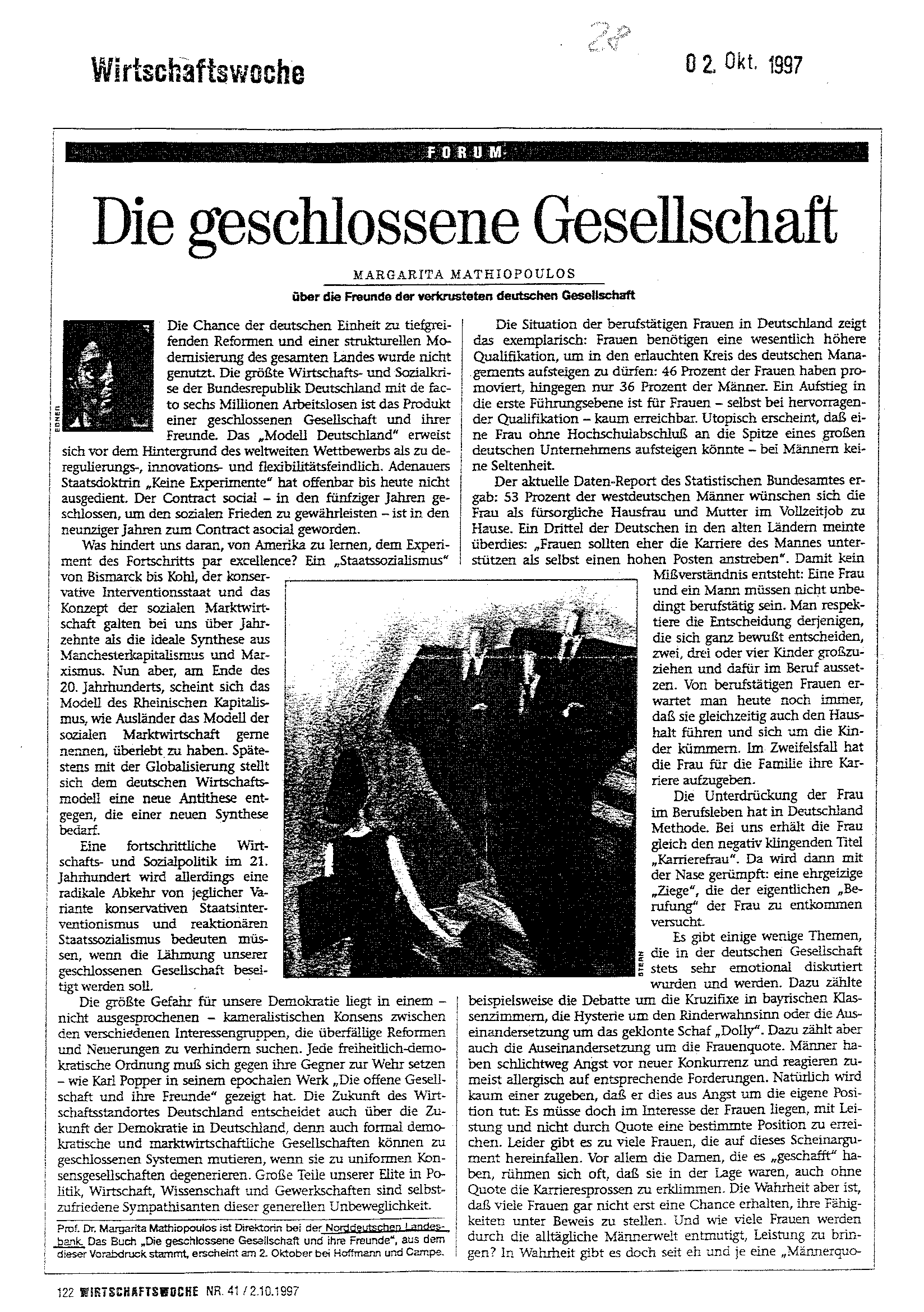
- Wirtschaftswoche (page 1, page 2)
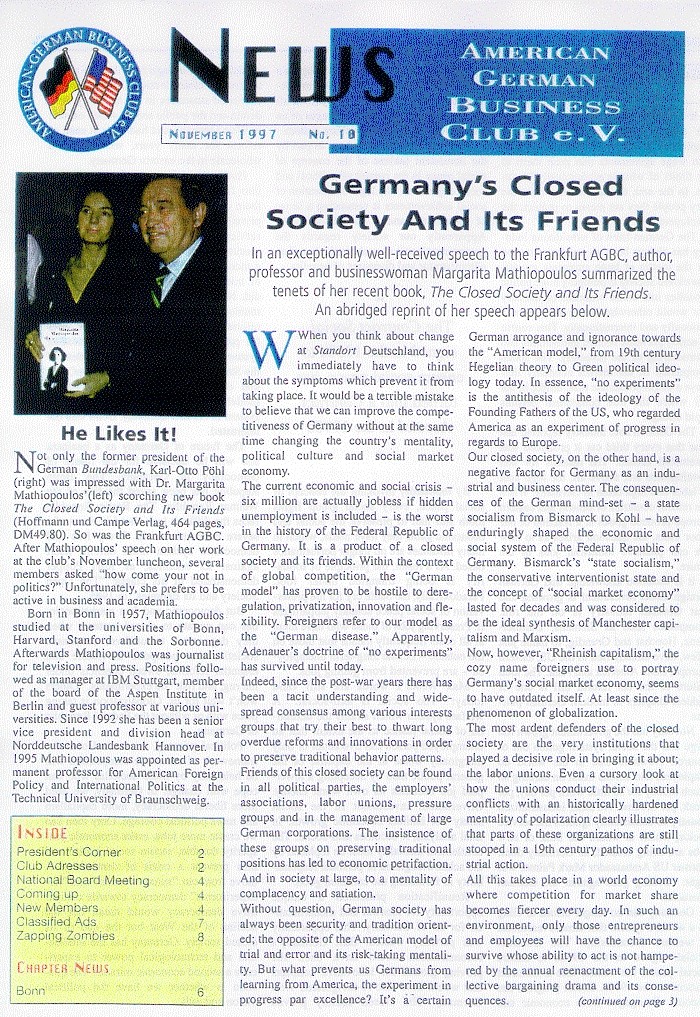
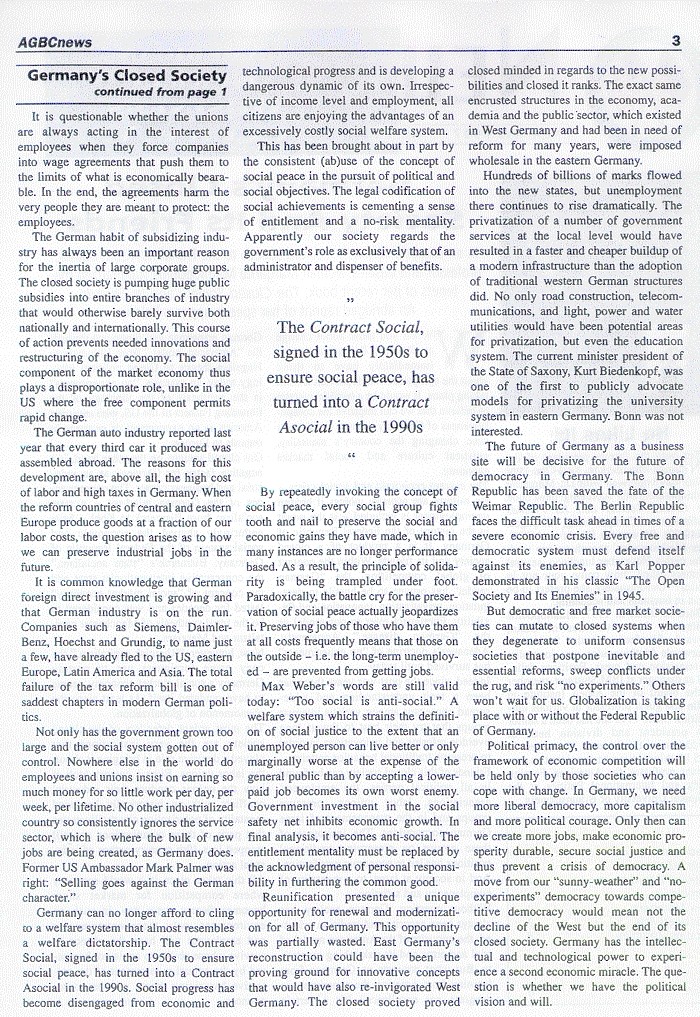
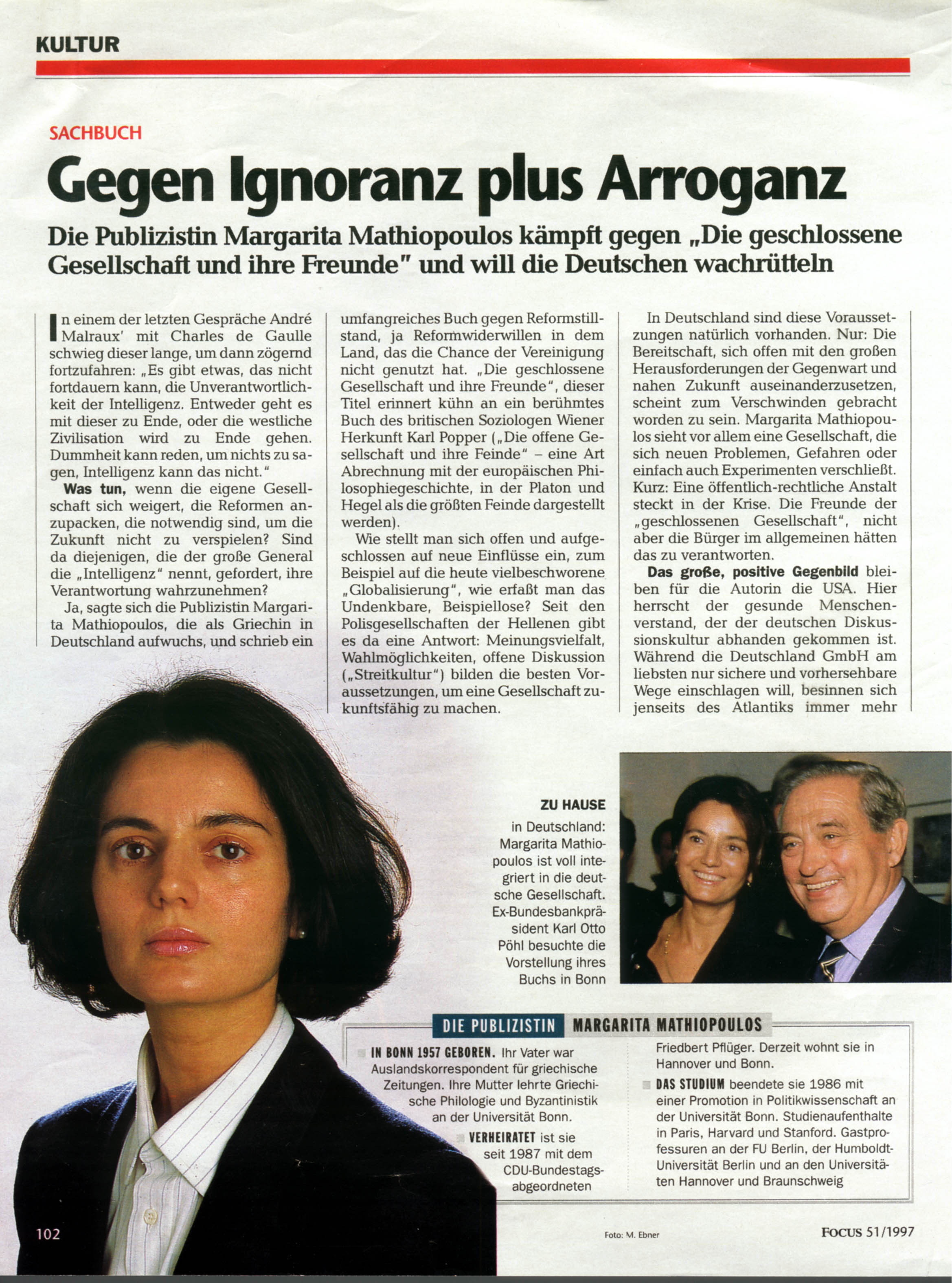

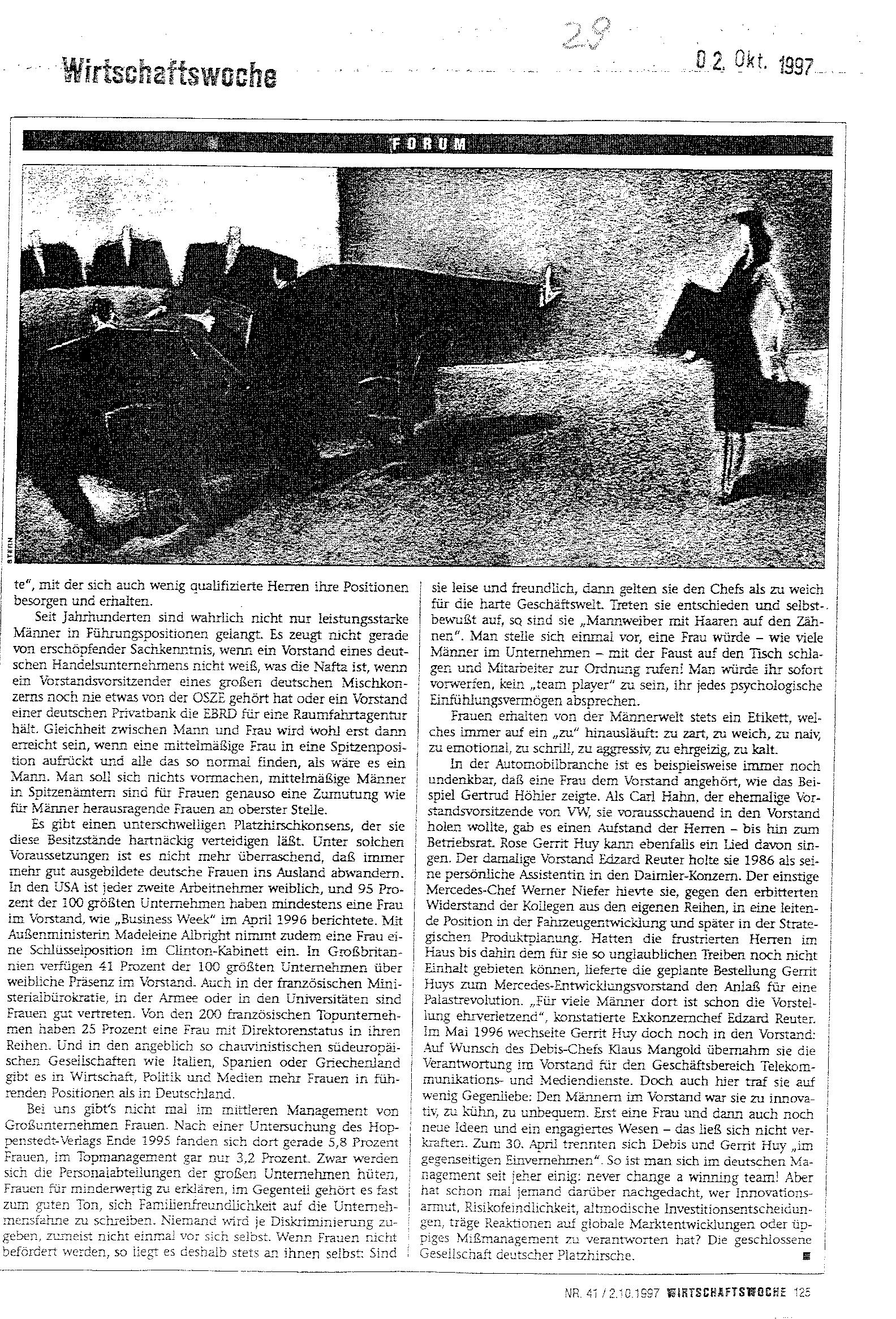
Note: Most of the reviews and press articles are scanned images of the original publication and may cause long download times. Please refer to downloads for file sizes.